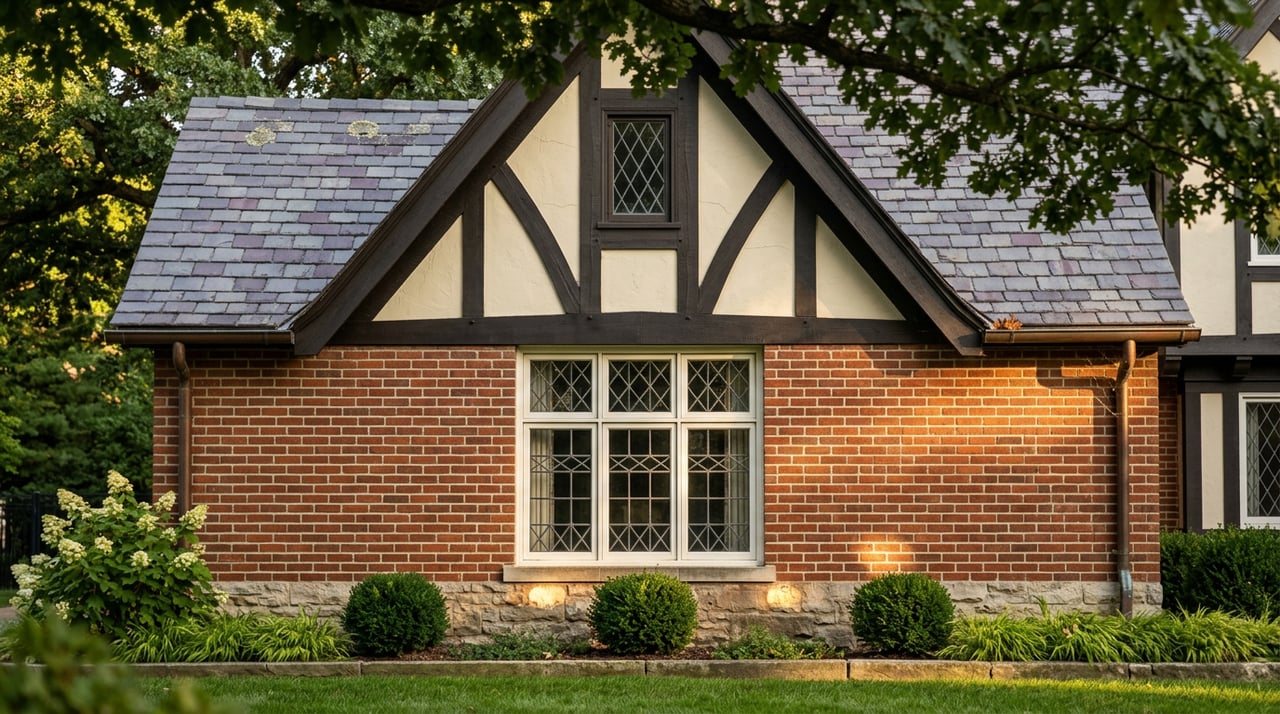
The headline number for Mission Hills in July 2026 was a median list price of roughly $2.04M. The active listings that produced it ranged from a $425,000 lot on Ensley Lane to a $5.5M estate on West 63rd Street. If you are shopping this market from a portal search, the median is telling you almost nothing useful. It is the average of a bimodal distribution, and the two modes sit on opposite sides of the same street grid.
Buyers who move confidently in Mission Hills understand that the city is running three parallel price ladders, that the inventory mechanic behind those ladders is different from every other Johnson County suburb, and that architectural provenance quietly does more work in pricing than square footage does. Everything below is evidence for that claim.
Three price ladders hiding inside one median
Mission Hills is roughly two square miles, and 63rd Street cuts it into two informally recognized halves. North of 63rd is what long-time residents call "old Mission Hills," dominated by opulent houses on large lots and anchored by Kansas City Country Club and Mission Hills Country Club. South of 63rd runs a set of subdivisions — Belinder Hills, Indian Hills, and Sagamore Hills — with the private Indian Hills Country Club as the southern anchor. Homes.com's local guide sums the range as $1 million to $7.5 million, but the distribution inside that range is not smooth.
Instead, three ladders operate at once:
- The estate ladder. North-of-63rd houses on half-acre-plus lots, often with architectural attribution to Edward Tanner, Edward Buehler Delk, or Clarence Shepherd. These sales anchor the top end of the market, from roughly $2M to well past $5M.
- The classic Mission Hills ladder. One-and-a-half stories and brick colonials in the $1.4M to $2.2M band, often in Sagamore Hills or on the smaller "old Mission Hills" lots. This is where most transactions actually happen.
- The entry ladder. Ranch homes and cottages in the $700K to $1.3M band, more common south of 63rd and on the district's perimeter. Zillow's ZHVI put the average Mission Hills home value at $1,542,818 as of January 2026, up 11.6% year over year, which is functionally the midpoint of this ladder and the classic ladder combined.
Two houses on the same block can sit on different ladders, and the ladders do not track each other in a given quarter.
| Sub-market signal | Northern half of the city | Southern half of the city |
|---|---|---|
| Anchor institutions | Kansas City Country Club, Mission Hills Country Club | Indian Hills Country Club |
| Typical lot | Half-acre and up, often wooded | Quarter-acre to half-acre |
| Common style | Tudor Revival, Georgian, Colonial Revival estates | Ranch, one-and-a-half brick, mid-century |
| Where the ladder tops out | Estate ladder | Classic ladder |
Built out in 1949, and the friction that creates at the closing table
Mission Hills incorporated as a city in 1949, and the J.C. Nichols Company had platted it in 1914 on former mission lands. What that history means for a 2026 buyer is simple: the city is fully built out. There is no new construction inventory, and there will not be. The Redfin count in November 2025 showed ten sales that month, and Homes.com counted 93 sales in the trailing twelve months across the entire city.
That scarcity produces two specific pieces of transactional friction most buyers do not see coming.
First, the comp pool is thin enough that a single overpriced listing can sit visibly for months and drag the price expectations of the seller two doors down. A competing 2026 sell-side guide observed that well-priced Mission Hills homes typically go under contract inside 30 days while overpriced homes sit 60 to 90 days and pick up a stigma that is hard to shake in a market this small. As a buyer, that stigma is your leverage. A house that has been active 70 days here is not the same as a house that has been active 70 days in Overland Park. The seller has usually had exactly one difficult conversation with their agent, and you are the reason for the second.
Second, Redfin's November 2025 snapshot showed median days on market at 42, up sharply from 15 a year earlier, while the median sale price was $1.7M and the median price per square foot was $413, up 18% year over year. Both numbers being up at once is unusual. It reflects a market where fewer homes are trading, the ones that do trade are the well-restored ones, and the ones that linger are pulling the days-on-market figure up without discounting. Read that pattern carefully before writing an offer: the "average" Mission Hills sale is bimodal in speed, not just price.
Provenance is doing more work than square footage
In most Johnson County submarkets, price per square foot is a reasonable first-pass filter. In Mission Hills, it is a trap. The neighborhood was originally designed with landscape architecture by Hare & Hare, the Verona Columns installed at Ensley Lane and Overhill Road in 1925, and its early houses drawn by Clarence E. Shepherd, Edward Tanner, and Edward Buehler Delk. Buyers here pay for that authorship, and they pay a discount for renovations that erase it.
Two practical rules follow from that.
A thoughtfully restored Tudor almost always outsells a heavily modernized version of the same footprint on the same street. Original leaded glass, stone fireplaces, hardwood floors, and crown moldings are assets to underwrite, not deferred maintenance to price around. Buyers looking at a listing with those details intact should assume competing offers from people who understand the provenance premium.
Updated mechanicals with period-appropriate finishes sell at the top of the ladder they sit on. New HVAC, updated electrical, and a kitchen that reads 1928 with 2024 appliances is the modal renovation strategy for a reason. Buyers walking into a house where the systems have not been touched should model the capital expense honestly. In a market this thin, sellers with fresh systems will not credit you for what you cannot see.
There is one exception worth naming. The "once-in-a-generation" estate offerings, several of which have hit the market in 2026 including a 1.53-acre parcel positioned as a redevelopment opportunity, follow their own logic. Land value dominates, and the improvement is priced as optional.
How to read a comp set here without getting fooled
The Heartland MLS feed will hand you a list of recent Mission Hills sales. Before you weight any of them, sort by three variables the portals do not surface cleanly.
Which side of 63rd Street the property sits on. This is the single strongest predictor of which ladder the comp belongs to.
Whether the sale involved a country club membership consideration. Kansas City Country Club, Mission Hills Country Club, and Indian Hills Country Club all sit inside or immediately adjacent to the city, and buyer motivation on specific streets is often driven by proximity to a specific club rather than by house features.
Whether the renovation history preserved or replaced original architectural elements. Comps that look identical on paper can sit $200 to $400 per square foot apart because one preserved the leaded glass and the other replaced it with vinyl in 2008.
Once those three filters are applied, a five-comp set often collapses to two usable comps. That is a feature of the market, not a failure of the search. Buyers who insist on a broader comp set end up importing sales from Prairie Village or Fairway, both of which sit on different price mechanics.
FAQ
Is 2026 a buyer's market or a seller's market in Mission Hills? Neither, cleanly. Redfin scored the market 89 out of 100 for competitiveness in late 2025, and the twelve-month sale count of about 93 homes is low by historical standards. Well-restored homes on the classic ladder move quickly. Estate-ladder homes and overpriced listings sit. Which market you are in depends on which ladder your target house sits on.
How much does country club membership factor into pricing? It rarely appears on the MLS sheet, and it should not be assumed. Kansas City Country Club, Mission Hills Country Club, and Indian Hills Country Club each have their own membership processes, and a home sale does not convey membership. Buyers who care about club access should treat that as a separate, parallel process and not price it into their offer.
Why does the Zillow ZHVI look different from the Redfin median? They are measuring different things. ZHVI is a modeled value index across the full housing stock and put the January 2026 average at $1,542,818. Redfin's median sale price of $1.7M in November 2025 is the middle of what actually transacted that month. In a thin market with a bimodal distribution, the two numbers can diverge by six figures and both be technically correct.
Can I tear down and rebuild? Occasionally, yes. A 1.53-acre Mission Hills parcel was actively marketed in 2026 as a redevelopment opportunity. But the city's design controls trace back to housing covenants the Mission Hills Home Company began enforcing in 1914, and any redevelopment plan should be pressure-tested against current design review before a purchase price is agreed.
If you are underwriting a specific Mission Hills house this quarter and want a comp set filtered the way this post describes rather than the way a portal auto-generates it, LUX Network KC will build one for you and walk you through it in person. Start with a free home valuation or a private consultation, and we will meet you at the property.